



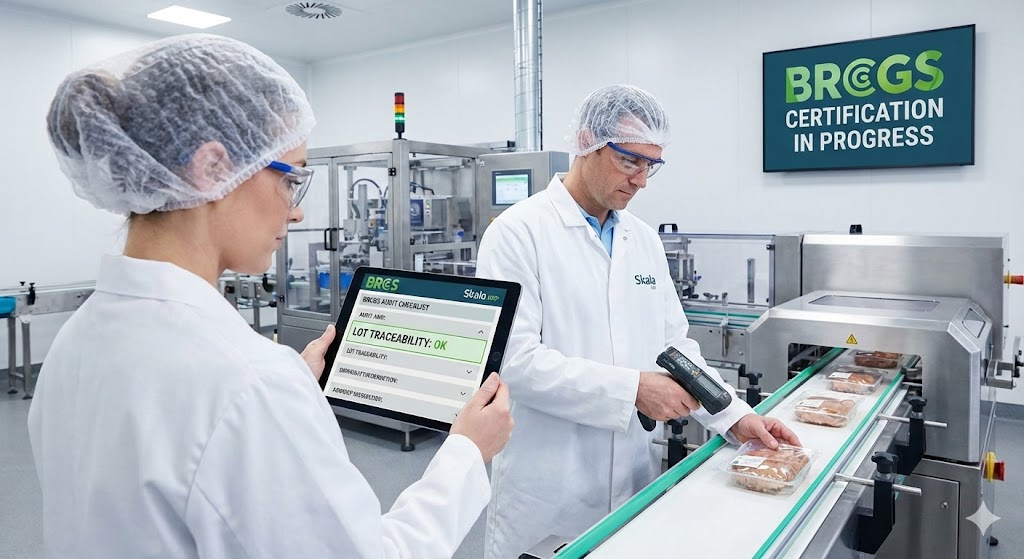
The Ultimate Guide to BRCGS Certification (2026): Steps, Prep & Traceability
If you are a food manufacturer aiming for the global market, obtaining the BRCGS certification is not just about hanging a document on the wall—it is the ultimate proof of trust for your retailers and customers. Whether you are targeting major European supermarket chains or looking to export worldwide, this standard is often non-negotiable.
However, for many Quality Assurance managers, the road to BRCGS certification means piles of paperwork and the stress of “traceability” tests.
In this guide, we will walk you through the 5 essential steps to get certified and explain how to master the toughest part of the audit: Lot Traceability, using digital tools.
About BRCGS: https://www.brcgs.com/
What is BRCGS and Why Does It Matter?
BRCGS (Brand Reputation Compliance Global Standards) is a market-leading global brand that helps build confidence in the supply chain. Recognized by the GFSI (Global Food Safety Initiative), holding this certificate proves that your facility meets the highest standards of food safety, quality, and operational criteria.
5 Steps to Achieve BRCGS Certification
The process might look intimidating, but with a structured roadmap, it is entirely manageable.
1. The Gap Analysis
Before you start, you must answer: “Where are we now?” You need to assess your current facility conditions against the BRCGS requirements. This is where most physical issues (flooring, lighting, layout) are identified.
2. Establishing the HACCP Plan
The heart of BRCGS is the HACCP (Hazard Analysis and Critical Control Point) system. You must identify all physical, chemical, and biological risks in your production flow and determine your Critical Control Points (CCPs).
3. Quality Management System (QMS)
The standard relies on the principle: “Say what you do, do what you say.” All procedures and records must be complete.
- Pro Tip: Managing documentation on paper makes version control nearly impossible. Using a digital [Production Management System] reduces the workload by 60%.
4. Internal Audits
Before the real auditors arrive, you must audit yourself. Internal audits are your last chance to close the gaps and fix non-conformities.
5. The Audit Day
Once you select an accredited certification body, the audit date is set. If successful, you will receive your certificate after closing any minor non-conformities.
The Hardest Test: Traceability and Mass Balance
The most common reason for “Major Non-Conformities” during a BRCGS certification audit is Traceability.
The auditor will typically pick a finished product at random and give you 4 hours to prove:
- Which supplier did the raw materials come from?
- When did they arrive?
- Which other products contain this specific batch of raw material?
- Who produced it, on which machine, and at what time?
Manual vs. Digital Traceability
If you are trying to track this using Excel spreadsheets or paper forms, that 4-hour window can turn into a nightmare. One wrong digit in a Lot Number can break the entire chain.
The Skala MRP Solution: With an end-to-end system like [Skala MRP], this process takes seconds, not hours. From the moment raw materials enter the warehouse, they are tracked via barcodes. When an auditor asks for a product, you can generate a “Backward Traceability Report” instantly, showing the entire genealogy (Supplier -> Production -> Shipment).
This speed and transparency build immense trust with the auditor.
Pre-Audit Checklist (Downloadable)
Ensure these 5 items are ready before the auditor walks in:
- Senior Management Commitment: Is your Quality Policy signed and displayed?
- Internal Audit Reports: Are the latest actions closed and documented?
- Goods Receipt Records: Is every raw material approved and logged?
- Calibration: Are scales and measuring devices calibrated?
- Mock Recall: Have you performed a recall test in the last 12 months?
The journey to BRCGS certification is demanding, but it elevates your business to a world-class level. You don’t have to rely on outdated manual methods to manage this complexity.
A fully integrated MRP software not only helps you pass the audit but also reduces waste and increases efficiency.
To see how Skala MRP can support your BRCGS journey and digitize your traceability,
